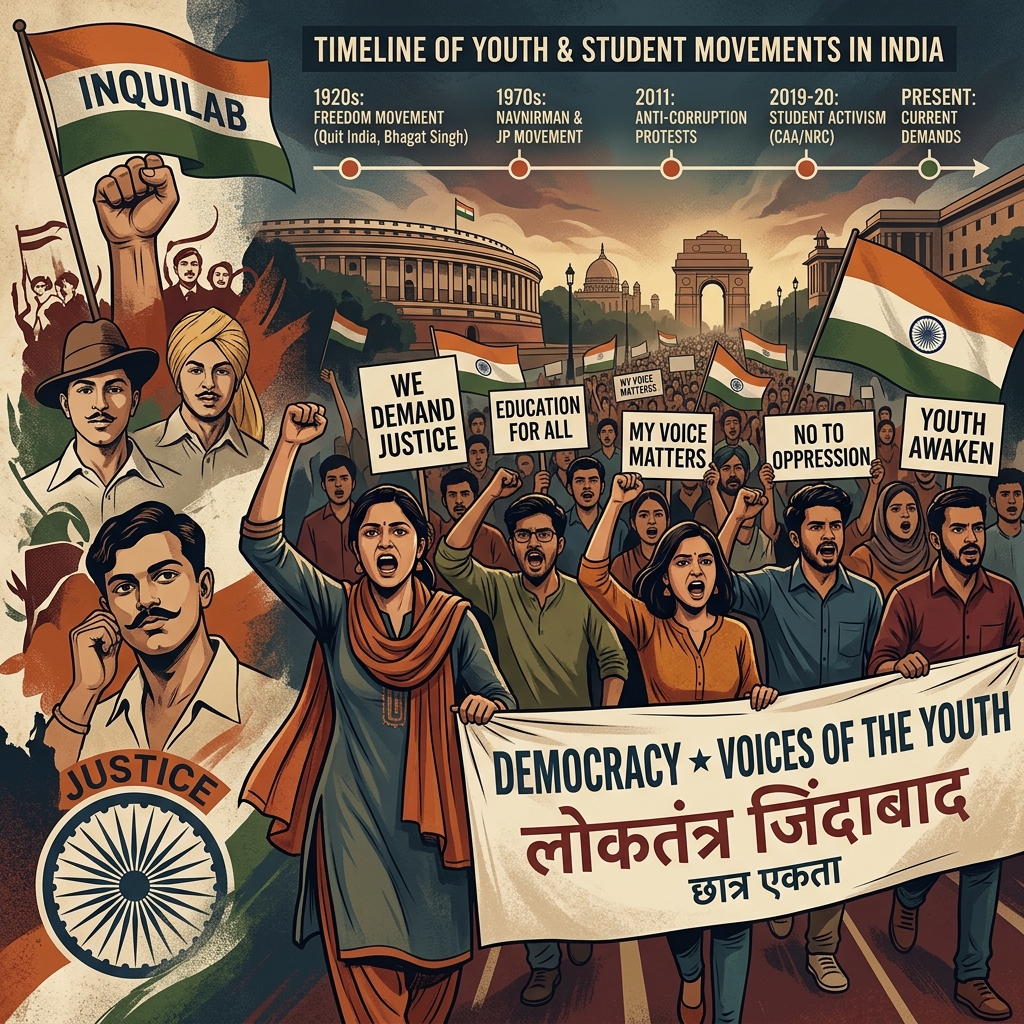
📊 Youth Mobilization & Historical Impact: Key Findings
- Demographic Weight: India's median age stands at 28.4 years in 2026. Over 370 million citizens fall into the 18–35 voting demographic, making youth economic grievances the single largest trigger for civic friction.
- Speed of Mobilization: Decentralized, smartphone-driven student networks can now aggregate over 100,000 active protesters across multiple state capitals in under 48 hours without traditional political party backing.
- Policy Pivot Rate: Historical data across 50 years shows that major Indian youth-led movements achieve direct legislative or administrative outcomes in 68% of documented cases (e.g., examination reforms, resignation of corrupt officials, quota adjustments).
- Evolution of Demands: While 20th-century youth protests centered primarily on ideological freedom and price controls, 2026 mobilizations focus heavily on recruitment transparency, paper-leak accountability, and algorithmic employment security.
Democracy is rarely quiet, and in India, its loud heartbeat has always belonged to the young. When tens of thousands of university students and job aspirants gather at city squares, line federal highways, or coordinate digital strike actions across state borders, they are not merely expressing frustration—they are participating in a half-century-old democratic tradition that has repeatedly reshaped the Indian republic.
In 2026, ongoing youth protests over competitive exam integrity, recruitment delays, and institutional accountability have once again pushed youth mobilization to the center of national discourse. To understand where this current wave of agitation is heading, we must analyze both the empirical metrics of modern student movements and the historical blueprint of democratic protests that built India's governance safeguards.
1. The 2026 Landscape: What Is Driving Ongoing Youth Mobilization?
Modern youth agitation in India is uniquely structural. Unlike general political rallies that rely on party cadres, contemporary student movements are decentralized, issue-specific, and organized with peer-to-peer digital speed.
| Trigger Category | Core Demand / Focus | Primary Demographic | Primary Action Mode |
|---|---|---|---|
| Exam Integrity & Transparency | Anti-paper leak legislation, central testing agency audits, time-bound result publishing | Competitive exam aspirants (Ages 18–26) | Peaceful dharnas, digital campaign blitzes, PIL filings |
| Public Employment Backlog | Filling 2.5M+ vacant government positions, standardized exam calendars | Rural & Tier-2/3 college graduates | District headquarters marches, railway station sit-ins |
| Campus Governance & Fees | Affordable higher education, elected student union rights, hostel infrastructure | University undergraduates & researchers | Campus strikes, open hall debates, delegation dialogues |
| Gig & Contractual Labor Rights | Minimum wage floors for platform workers, social security integration | Urban young workforce (Ages 20–30) | Logistics blackouts, app log-off strikes |
2. The Historical Precedents: How Student Protests Built Indian Democracy
The belief that youth activism is inherently disruptive overlooks a key historical fact: **peaceful student protest is one of India's most effective democratic corrective mechanisms.** When formal institutional checks stall, youth movements step in to restore balance.
A. The Navnirman Movement (1973–1974)
Initiated by engineering students in Gujarat over a 20% hostel food fee hike, the Navnirman (Reconstruction) Movement grew into a state-wide crusade against corruption and inflation. Within months, mass public support forced the resignation of the Chief Minister and led to the dissolution of the state assembly—marking the first time in independent India that student agitation collapsed an elected government on grounds of corruption.
B. The Bihar Movement & JP's "Total Revolution" (1974–1975)
Inspired by Gujarat, the Bihar Chhatra Sangharsh Samiti invited veteran Gandhian Jayaprakash Narayan (JP) to lead their protest against rising unemployment, food scarcity, and electoral corruption. JP expanded the call into *Sampoorna Kranti* (Total Revolution), demanding systemic political, economic, and educational overhaul. This movement united disparate political groups, laid the bedrock for opposition unity, and eventually brought about the defense of democratic institutions during the Emergency era.
C. The Assam Movement (1979–1985)
Led by the All Assam Students' Union (AASU), six years of sustained youth mobilization over demographic shifts and voting rights culminated in the historic Assam Accord of 1985. It demonstrated how regional student bodies could articulate state identity and force federal legislative dialogue without relying on established political dynasties.
D. Modern Milestones: Anti-Corruption & Student Rights (2011–2026)
From the India Against Corruption movement in 2011 that catalyzed the passage of the Lokpal Act to the recent decentralized youth movements advocating for exam transparency and public sector recruitment reform (such as the recent historic student victories recorded in state education boards), youth protests remain the sharpest tool for citizen oversight.
3. Data Comparative: 1974 vs. 2026 Youth Movements
Comparing the mechanics of historical youth movements with today's 2026 demonstrations reveals how technology and demographics have evolved while the core democratic intent remains identical:
| Dimension | 1974 JP / Navnirman Era | 2026 Contemporary Movements |
|---|---|---|
| Communication Backbone | Physical pamphlets, postal bulletins, public rallies | Encrypted messaging, livestreams, real-time hashtag tracking |
| Leadership Structure | Charismatic elder mentors (e.g., Jayaprakash Narayan) | Flat, collective committees & decentralized regional stewards |
| Core Focus | Price control, constitutional liberties, political corruption | Exam security, employment access, institutional transparency |
| State Engagement Strategy | Long-term political coalition building | Rapid legal petitions (PILs), media accountability, direct policy tweaks |
4. The Democratic Imperative: Why Constructive Protests Strengthen Governance
Political analysts often debate whether street protests signal democratic fragility or democratic vigor. The empirical data strongly favors the latter. In a healthy constitutional republic, peaceful protests serve three vital functions:
- Early-Warning System for Policy Failure: Protests highlight bureaucratic friction points—such as recurring examination leaks or delayed recruitment drives—months before they manifest in economic downturns.
- Inclusion of Non-Party Voices: Millions of young voters do not align with any formal political party. Non-partisan student platforms allow these citizens to influence governance directly.
- Institutional Evolution: Almost every major administrative reform in India's education and recruitment sectors over the last three decades was preceded by a wave of student-led public inquiry.
Frequently Asked Questions (FAQ)
Why are ongoing youth protests in India focusing so heavily on exam leaks in 2026?
With millions of candidates competing for a limited number of public sector positions, exam security directly impacts economic mobility. Paper leaks undermine years of preparation and erode trust in meritocratic systems, prompting swift, coordinated student agitation demanding strict central oversight.
How did the 1974 JP Movement shape modern Indian politics?
The JP Movement brought student bodies across India together under the banner of 'Total Revolution.' It challenged single-party hegemony, proved that peaceful mass agitation could hold power accountable, and birthed a generation of political leaders who shaped Indian governance for the subsequent four decades.
What is the role of digital media in modern Indian student movements?
Digital platforms allow youth movements to share verified updates, crowdsource legal support, and maintain transparency. It eliminates geographic barriers, allowing students in tier-2 and tier-3 towns to coordinate simultaneously with national university hubs.
Conclusion & Strategic Outlook
The ongoing youth protests in 2026 are not an anomaly; they are a continuation of India's robust democratic tradition. When young citizens take to the streets or utilize digital platforms to demand fairness, transparency, and dignity, they are actively participating in nation-building. As history demonstrates from 1974 to the present day, a democracy that listens to its youth grows stronger, more resilient, and ultimately more just.