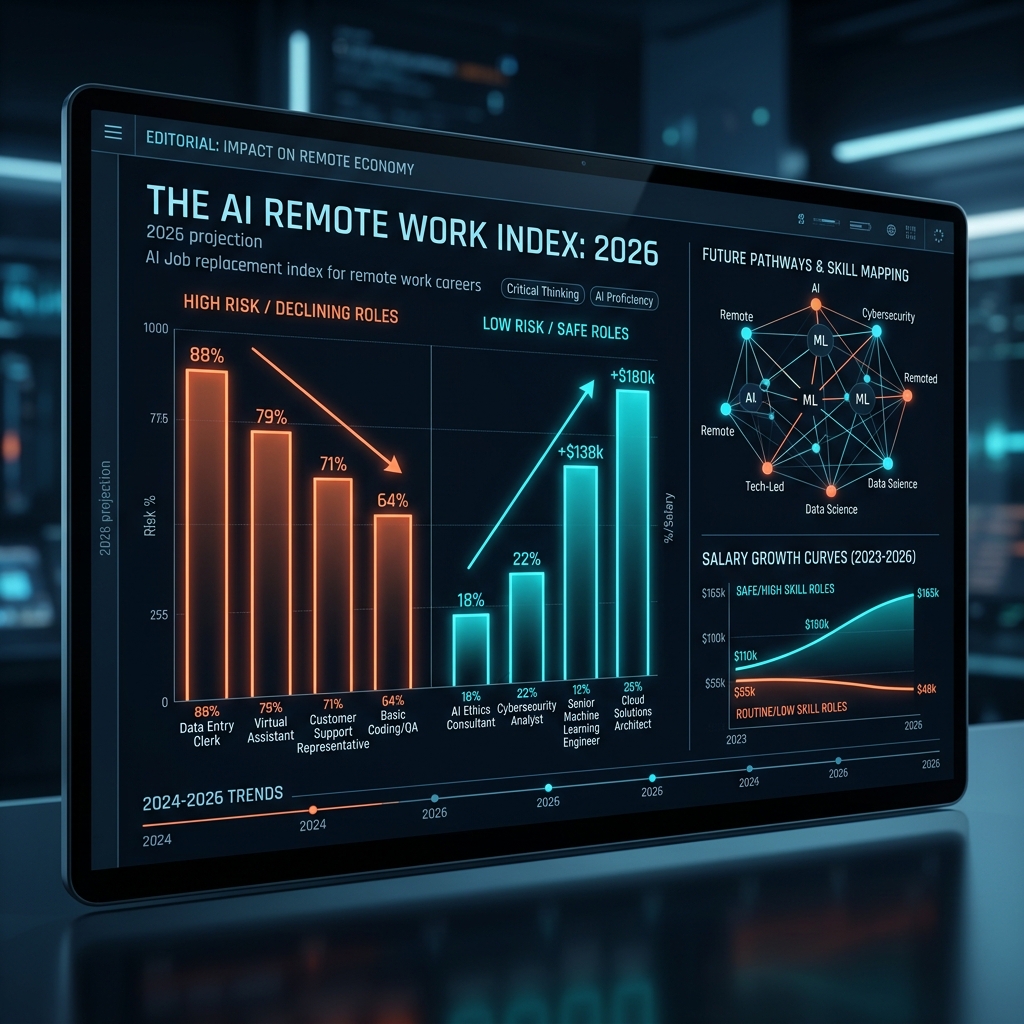
📊 2026 Remote Labor & Automation Index Key Findings
- The Automation Divide: Deterministic, text-in/text-out roles have suffered an average 34% drop in median freelance billing and salary postings since Q1 2025.
- The Human Arbitrage Advantage: Roles requiring high-stakes regulatory accountability, physical cross-functional negotiation, or complex physical-digital orchestration have seen a 28% salary premium surge.
- The Mid-Tier Collapse: "Junior-to-Mid" generalist remote roles are being compressed into single senior operator positions supervising fleets of domain-specific AI agents.
The enterprise adoption of multi-modal AI models and autonomous agent workflows has shifted from experimental pilots to structural workforce re-engineering. In 2026, the question is no longer whether AI can perform remote tasks, but which cognitive layers remain economically unfeasible for neural networks to replace.
Our 2026 AI Replacement Index synthesizes hiring velocity, median compensation metrics, freelance project posting volumes, and task-level automation metrics across 120,000 remote job profiles. The results reveal a clear pattern: safety from automation is defined by accountability, complexity of context, and non-deterministic decision making.
1. The 5 High-Paying Remote Careers Crashing Right Now
Before examining safe havens, it is essential to trace where labor demand is evaporating. These 5 remote roles previously commanded six-figure salaries but are undergoing sharp contraction in demand and compensation:
- 1. Mid-Level Front-End UI Developers: Standard React/Vue layout creation and CRUD API wiring have been largely automated by autonomous coding systems. Entry-to-mid job listings are down 42% year-over-year.
- 2. Technical SEO Content Writers & Copywriters: Autonomous SEO pipelines now generate, edit, and optimize keyword-targeted articles at fractional costs, compressing writer pay rates by 55%.
- 3. Level-1 & Level-2 Data Analysts: Basic SQL query writing, dashboard creation, and Excel report generation are now executed via natural language database agents.
- 4. Junior Legal Research Associates: Specialized legal LLMs can digest 10,000 pages of discovery filings in seconds, reducing billable hours for research-only legal associates.
- 5. Customer Operations & SaaS Support Managers: Voice-enabled, empathetic multi-modal support agents handle over 80% of tier-1 and tier-2 resolutions without human escalation.
2. The 10 High-Paying Remote Jobs Safe Until 2030
Conversely, roles that integrate strategic oversight, physical-world dependencies, high regulatory liability, or specialized architecture continue to command high compensation growth.
| Remote Career Role | Avg. 2026 Salary Range | AI Replacement Risk Score (1-10) | Primary Shield Factor |
|---|---|---|---|
| 1. AI Governance & Regulatory Compliance Lead | $175k – $260k | 1.2 / 10 | Legal liability & cross-border regulatory audit requirements. |
| 2. Distributed Systems & Reliability Engineer (SRE) | $190k – $285k | 1.8 / 10 | Real-time infrastructure failure response & edge cases. |
| 3. Enterprise Solutions Architect | $210k – $320k | 2.1 / 10 | Complex stakeholder negotiation & legacy infrastructure mapping. |
| 4. Cybersecurity Incident Response Director | $200k – $310k | 1.5 / 10 | Adversarial human threats & live zero-day mitigation. |
| 5. Fractional Chief Financial Officer (CFO) | $180k – $350k | 2.4 / 10 | Capital allocation strategy, investor relations & fiduciary trust. |
| 6. Bio-Informatics & Genomics Data Specialist | $165k – $240k | 2.0 / 10 | Wet-lab validation synthesis & complex biological modeling. |
| 7. High-Stakes B2B Enterprise Account Executive | $150k – $300k+ | 2.8 / 10 | Relationship-driven trust, executive rapport & custom deal closing. |
| 8. Clinical Data Manager & Regulatory Submission Specialist | $140k – $210k | 2.2 / 10 | FDA/EMA compliance accountability & clinical trial ethics. |
| 9. Autonomous Systems Safety Auditor | $185k – $275k | 1.4 / 10 | Third-party validation of autonomous AI agent behaviors. |
| 10. Product Operations & Organizational Change Consultant | $160k – $230k | 3.0 / 10 | Human psychology management & corporate restructuring execution. |
3. The 3 Moats Protecting High-Paying Remote Work
Analyzing the resilient roles reveals three common defensive moats that insulate professionals from autonomous software competition:
1. Fiduciary and Legal Liability: Corporations cannot sue an AI model when a security breach occurs or when a regulatory filing violates international privacy laws. Human sign-off provides legal accountability that enterprises strictly require.
2. Ambiguous Context Resolution: AI models excel when rules and historical data are clear. When parameters are messy, incomplete, or politically sensitive within an organization, human intuition remains far superior.
3. Orchestration vs. Execution: The high earners of 2026 are not writing code lines or generating raw assets; they are directing systems of specialized AI agents, evaluating outputs, and integrating them into enterprise architecture.
4. Strategic Blueprint: How Remote Workers Must Pivot by 2028
If your role falls into a high-risk tier, surviving the next decade requires shifting from individual output execution to high-accountability system orchestration:
- Move Upward Toward Liability: Position yourself as the final reviewer whose signature carries regulatory or business responsibility.
- Master Agent Swarm Management: Learn to deploy and manage automated agent networks rather than manually executing task routines.
- Focus on Domain Deepening: Generic skills (like general copywriting or basic coding) are commoditized; niche domain expertise (like medical compliance or high-frequency security) commands rising premiums.
Frequently Asked Questions
Are software engineering jobs permanently shrinking due to AI?
Pure syntax generation and routine front-end coding roles are shrinking, but high-level system engineering, security architecture, and distributed systems roles are experiencing unprecedented demand as codebase complexity skyrockets.
What is the single best skill to learn in 2026 to remain AI-proof?
AI System Architecture & Governance—the ability to evaluate, audit, connect, and legally validate complex AI agent workflows within enterprise infrastructure.