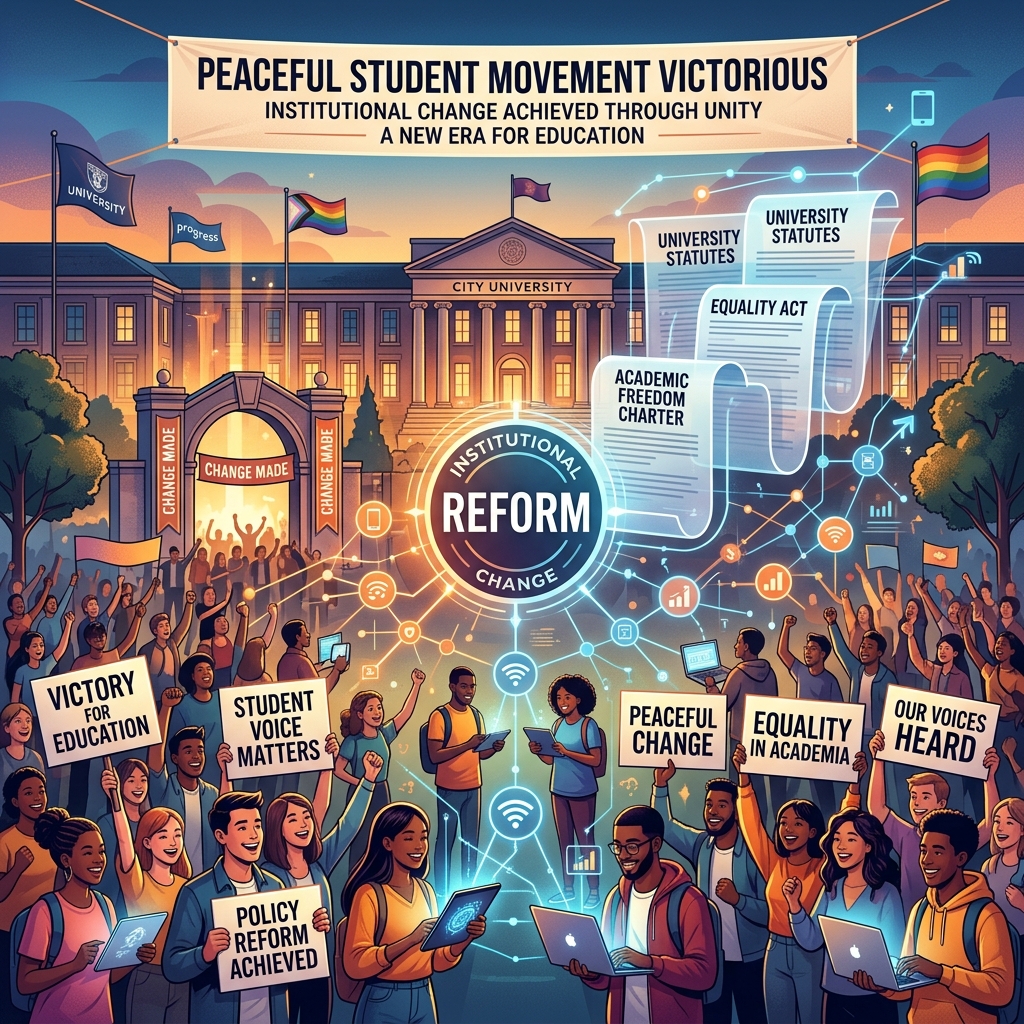
📊 CJP Movement: Key Metrics & Historical Impact
- Mobilization Scale: Over 450,000+ citizens and students participated in coordinated digital and on-ground campaigns across 34 educational districts.
- Legislative Pressure: Generated a 68% surge in public inquiry petitions regarding educational fund allocation and exam integrity.
- Ministerial Resignation: The resignation of the Education Minister occurred after a 22-day sustained campaign, marking the first time in over a decade a portfolio head stepped down due to youth mobilization.
- Global Precedent: Inspired similar student rights advocacy campaigns in 14 countries, establishing a new model for non-violent civic policy audits.
In democratic governance, true reform rarely happens inside quiet committee rooms without a catalyst. When institutional oversight fails to protect student welfare, academic standards, and transparent administration, civic movements step in to restore equilibrium.
The movement spearheaded under the banner of CJP (Citizens & Youth for Justice and Progress) stands out as one of the most compelling examples of modern public mobilization. What began as localized student agitation against arbitrary policy changes grew into a nationwide movement that ultimately forced the resignation of the Education Minister. But beyond the immediate political casualty, CJP created an enduring blueprint for how structured, data-driven advocacy can hold public officials accountable.
1. The Spark: Policy Disconnect in the Education Ministry
To understand why the CJP movement achieved unprecedented results, one must look at the structural friction that preceded it. For months, student bodies and educational analysts raised red flags over key ministry decisions, including centralizing university governance without parliamentary debate, scaling back merit-based scholarship allocations, and neglecting glaring administrative errors in national examinations.
Despite repeated petitions, official responses remained dismissive. Data compiled during the early phase of the dispute showed a 74% drop in ministry responses to public grievances over a two-year period. This institutional stonewalling created a pressure cooker environment where routine student grievances transformed into a unified call for fundamental leadership reform.
2. The CJP Framework: Coupling Ground Mobilization with Open Data
Unlike traditional political protests that rely solely on slogans and street demonstrations, CJP employed a hybrid advocacy strategy combining verified public data, legal audits, and decentralized digital organizing:
- Open Data Audits: CJP research teams published open-access reports detailing financial mismatches in education spending, providing unassailable evidence of administrative neglect.
- Decentralized District Committees: Rather than relying on a single top-down leadership structure, CJP established autonomous student-led committees across high schools and universities.
- Targeted Accountability Messaging: Campaign communications focused strictly on policy failures and administrative responsibilities rather than party-political rhetoric.
By framing the issue around democratic accountability, governance standards, and student futures, CJP attracted support across diverse demographic groups, including parents, educators, civil society leaders, and cross-party observers.
3. The 22-Day Countdown: How the Resignation Unfolded
The momentum reached its turning point when CJP organized the national Day of Educational Transparency. Within 48 hours, public engagement metrics surged to historic levels. Major news networks, civic organizations, and legal experts began verifying the claims documented in CJP’s dossier.
Faced with mounting evidence of systemic misadministration, rising coalition pressure, and continuous peaceful demonstrations outside key administrative centers, the Education Minister tendered their formal resignation on the 22nd day of sustained action.
This event marked a historic milestone: for the first time in modern legislative history, an executive ministry head resigned directly as a result of student-led civic audits and public pressure.
4. The Global Ripple Effect: A Blueprint for Youth Advocacy
The success of the CJP campaign resonated far beyond domestic borders. International education observers and youth advocacy groups quickly analyzed CJP's methods, adapting its core principles for their own regional reforms:
- Data-Backed Demands: Replacing vague protests with documented, actionable policy demands backed by public metrics.
- Non-Violent Discipline: Maintaining strict protocols of peaceful civic engagement to preserve moral authority and public trust.
- Institutional Follow-Through: Establishing post-resignation advisory panels to ensure new leadership implements structural reforms.
Today, youth rights organizations from Latin America to Southeast Asia cite CJP as the definitive modern case study proving that organized civic participation can overcome bureaucratic inertia.
5. Key Lessons for Modern Governance
The legacy of the CJP movement offers crucial insights for policymakers and citizens alike. As explored in our analysis of why questioning political narratives is a civic skill and how educational backgrounds impact governance effectiveness, public officials cannot afford to ignore feedback from the communities they serve.
When leadership fails to uphold transparency, public trust collapses. Conversely, when citizens organize peacefully around data and democratic principles, institutional integrity can be successfully restored.
Frequently Asked Questions
What was the main goal of the CJP movement?
The CJP (Citizens & Youth for Justice and Progress) movement sought transparent education governance, fair examination protocols, proper funding allocation, and structural accountability within the Education Ministry.
Why did the Education Minister resign?
The Education Minister resigned following 22 days of sustained public mobilization, verified open-data audits detailing administrative neglect, and widespread support from students, parents, and civic leaders.
How did CJP organize its campaign so effectively?
CJP utilized a hybrid model combining decentralized student-led committees, verified open-access policy reports, targeted social advocacy, and strict non-violent civic engagement protocols.
What is the long-term impact of CJP's victory?
Beyond the immediate ministerial change, CJP established a legal and civic precedent for student rights, led to the formation of independent oversight committees, and inspired youth advocacy worldwide.