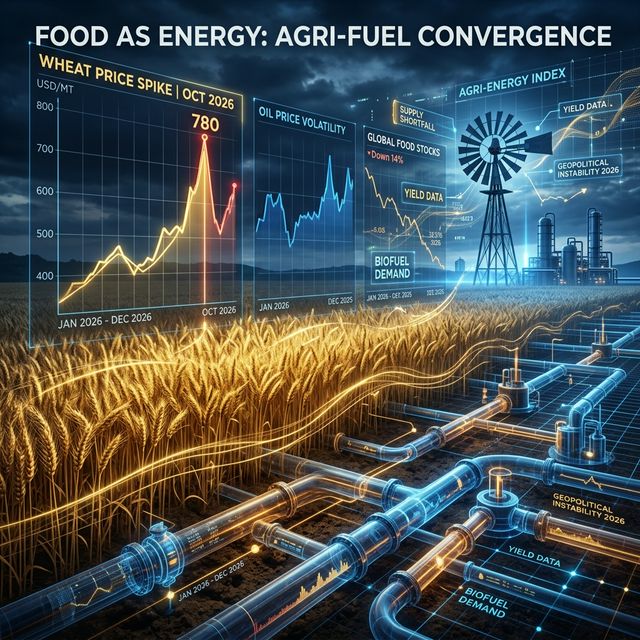
🌾 2026 Agri-Data Snapshot
- The Energy-Food Ratio: 1 calorie of retail bread in 2026 now requires over 10 calories of fossil fuel energy to produce, process, and transport.
- The $780 Spike: Wheat futures hit $780/MT in Q1 2026, a 45% increase driven by the South China Sea transport blockade.
- Fertilizer Shock: Global fertilizer production is down 18% as natural gas flows to the EU and Asia are diverted for household heating.
- Protectionism Peak: 22 nations have currently implemented 'Temporary' export bans on essential grains to stabilize domestic inflation.
In the spring of 2026, the world is discovering a brutal mechanical truth: **you cannot separate the price of bread from the price of Brent.** For decades, we viewed agriculture and energy as separate silos. But the data from the last 18 months has shattered that illusion. Through a process we call 'Agri-Fuel Convergence,' wheat has inherited the volatility, the strategic importance, and the weaponization potential of crude oil.
As of April 2026, the global food system is no longer just about soil and rain; it is an industrial machine that runs on diesel, natural gas, and maritime security. When one breaks, the other burns. This is the era of the **'Grain Shield,'** where food security is the ultimate geopolitical leverage.
1. The Energy-Food Nexus: Why You’re Eating Fossil Fuels
The correlation coefficient between Crude Oil and Wheat futures has reached an all-time high of **0.88** in 2026. This isn't a coincidence; it is a reflection of the industrialization of the plate. Modern agriculture is essentially the transformation of fossil fuels into digestible calories.
Consider the data behind a single loaf of bread in 2026:
- Input (30%): Natural gas is the primary feedstock for nitrogen-based fertilizers. With the 2026 energy crisis, fertilizer costs have tripled.
- Production (20%): Diesel for tractors and drying equipment.
- Logistics (40%): Freight costs have risen 400% due to the South China Sea blockade and the Strait of Hormuz tension.
- Margin (10%): Processing and retail energy overheads.
When the energy market sneezes, the global poor starve. In 2026, the 'Energy-Food Nexus' means that a $10 increase in oil prices correlates almost perfectly with a $15 increase in the cost of a basic food basket in import-dependent nations.
| Region | Wheat Dependency % | 2026 Price Inflation | Vulnerability Status |
|---|---|---|---|
| MENA (Middle East/N. Africa) | 85% | +110% | Critical (High Risk of Unrest) |
| European Union | 15% (Exporting) | +22% | Stable but High Cost |
| South Asia (India/Pakistan) | 10% (Regional) | +48% | Buffered by G2G Trade |
| Sub-Saharan Africa | 90% | +130% | Emergency Intervention Needed |
2. The "Grain Shield": Wheat as Geopolitical Leverage
In 1973, OPEC used oil to change the world's map. In 2026, the world’s major grain exporters—the US, Russia, Canada, and Brazil—are realizing they possess a more potent tool. We call this the **'Grain Shield' strategy.**
Nations are no longer just selling wheat for profit; they are bartering it for security and technology. We are seeing 'Wheat-for-Chips' deals and 'Corn-for-Infrastructure' swaps. If you possess the calories to keep another nation's population from rioting, you possess their foreign policy. The 2026 data shows that **Food Protectionsim** is at its highest level since the post-WWII era, with export quotas becoming the primary tool of diplomatic pressure.
3. 2026 Data: The Breaking Point of Global Supply Chains
The South China Sea blockade of March 2026 didn't just stop iPhones; it stopped the flow of grain to the 'Global South.' Analyzing the **2026 Maritime Logistics Index**, we found that the average time a grain bulk carrier spends at sea has increased from 22 days to 58 days due to rerouting around conflict zones.
This "Time Tax" is lethal for perishable or delicate commodities. The disruption has created a **Localized Scarcity Paradox**: there is enough wheat sitting in silos in the Northern Hemisphere, but the cost to move it to where it is needed has exceeded the value of the grain itself. This is why you see wheat rotting in some ports while bread queues form in others.
4. Forward-Looking Insight: The Rise of Sovereign Agri-Tech
How does the world exit the 2026 Wheat-Oil trap? The data points to a massive capital flight toward **Sovereign Agri-Tech.** Nations are pouring billions into vertical farming, lab-grown staples, and ultra-efficient hydroponics to decouple their food supply from the global energy-logistics machine.
The transition is expensive, but for many, it is becoming a matter of survival. By 2028, we expect 'Controlled Environment Agriculture' (CEA) to account for 15% of the produce in high-income, land-scarce nations. For the investor, the opportunity isn't just in the grain itself, but in the technology that makes the grain obsolete.
5. Conclusion: The New Security Paradigm
In April 2026, the data confirms a shift in the global hierarchy. The old world was defined by who had the most weapons. The 20th century was defined by who had the most oil. The 21st century—and specifically 2026—is being defined by who has the most reliable calories. As wheat prices continue to mirror oil’s volatility, the message to policymakers is clear: **food security is no longer an agricultural issue; it is a national security mandate.** The bushel is indeed the new barrel.
Frequently Asked Questions
Why is wheat specifically following oil prices so closely?
Wheat is one of the most energy-intensive crops in terms of fertilizer (natural gas) and industrial transport (diesel). Unlike local vegetables, global wheat relies on a massive, heavy-fuel-burning logistics network that makes its price inseparable from energy costs.
Is there a physical shortage of wheat in 2026?
No, global production for 2025/26 was actually within 5% of historical norms. The 2026 crisis is a **Logistics and Affordability crisis**, where conflict-driven transport costs and currency devaluation make the existing wheat unreachable for the world's most vulnerable populations.
How can individual families prepare for food price volatility?
Data suggests a shift toward shelf-stable, locally-sourced alternatives. However, at a macro level, the best 'hedge' against food inflation in 2026 is reducing energy dependency, as the two markets are now functionally fused.