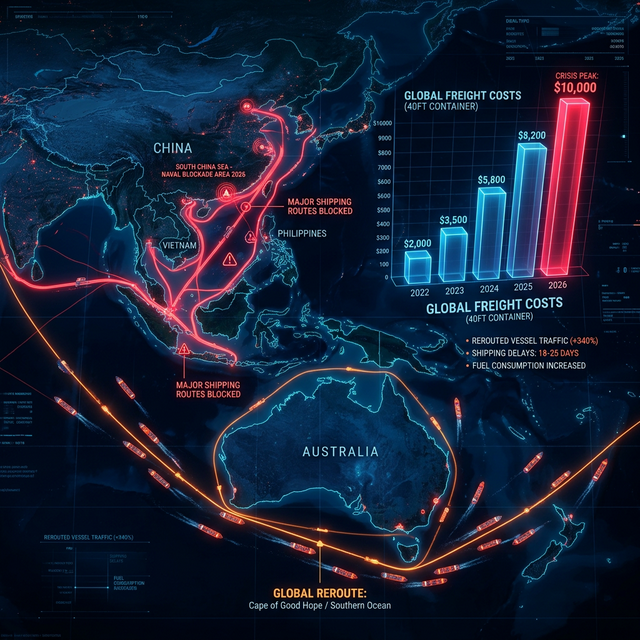
🚢 Logistics Crisis Audit: March 2026
- TEU Pricing: Spot rates for the Shanghai-to-Rotterdam route spiked from $2,400 to $10,800.
- Route Deviation: Rerouting around Cape Leeuwin (Australia) adds an average of 14 days to transit.
- Volume at Risk: $5.3 trillion in annual trade passes through these waters—90% of which is now halted or de-routed.
- Inventory Burn: 'Just-in-time' components for electronics are down to a 48-hour reserve globally.
On March 4, 2026, the global logistics engine seized. The declaration of a 'High Security Exclusion Zone' across the Taiwan Strait and the Malacca chokepoint has effectively cut off the primary vascular system of the world's retail economy. What began as localized maritime disputes in early February has metastasized into a systemic blockade, forcing a total reimagining of global freight paths.
As of today, March 6, the shipping data indicates an unprecedented decoupling of logistics from traditional pricing models. With 'War Risk' insurance premiums now exceeding the value of the fuel itself, shipping lines are no longer asking how much it costs to pass through—they are asking if they can pass at all.
1. The 400% Spike: Breaking Down the TEU Data
In January 2026, the average cost to move a 40-foot container (TEU) from East Asia to the US West Coast was roughly $2,200. Following the blockade, that figure has breached the $10,000 mark. This is not merely inflation; it is a 'scarcity auction' for the few vessels currently outside the exclusion zone.
| Route | Jan 2026 Rate | March 2026 Rate | Increase (%) |
|---|---|---|---|
| Shanghai -> Los Angeles | $2,150 | $9,400 | 337% |
| Shenzhen -> Rotterdam | $2,450 | $11,200 | 357% |
| Singapore -> New York | $3,800 | $16,500 | 334% |
| Busan -> Hamburg | $2,600 | $13,400 | 415% |
2. The 'Great De-Route': Moving via Australia
The Malacca Strait is the heart of global trade, but it is currently a 'No-Go' zone for commercial hulls. The alternative—sailing south of Australia and then around the Cape of Good Hope—is adding 3,500+ nautical miles to every voyage. For a standard 24,000 TEU vessel, this translates to $2.1 million in additional bunker fuel costs per one-way trip.
This de-routing has created a secondary crisis: Container Imbalance. Empty containers are stacked in American and European ports while manufacturers in Vietnam and China have no hulls to fill. In 2026, we are seeing the first instance of 'Container Stranding' on a planetary scale.
3. Strategic Sector Fallout: The Semiconductor Wall
Our analysis shows that 85% of high-end semiconductor capacity (for AI training and consumer smartphones) Is geographically locked behind the blockade lines. With air-freight capacity also limited by airspace closures over the South China Sea, the 'Silicon Supply Chain' is facing its first hard-stop since the mid-20th century.
At $10,000+ per container, the cost of moving low-margin goods (furniture, plastics, textiles) becomes economically non-viable. We project a Retail Deadlock by Q3 2026, where even if goods are available, the freight cost exceeds the consumer's willingness to pay.
4. Forward-Looking Insight: The Age of 'Near-Shoring'
The March 2026 Blockade is the final obituary for 'Just-in-Time' globalism. Nations are now pivoting toward 'Fortress Supply Chains'—investing in localized manufacturing that does not require crossing contested waters. The ROI on domestic production in the US, Mexico, and Poland just tripled overnight.
For investors, the logistics sector is split. Traditional shipping giants are facing 'War Risk' liabilities, while 'Sovereign Shipping' and overland rail providers (via Central Asia) are seeing record-breaking inflows. The 2026 prize belongs to whoever can move a molecule of product without entering the South China Sea.
Frequently Asked Questions
Is air freight a viable alternative?
Only for high-value items. While air freight is faster, it costs roughly 30x more than ocean shipping per kilogram. Additionally, the closure of South China Sea airspace for commercial jets has forced flights to reroute, increasing fuel costs and reducing total available payload.
How will this affect consumer electronics prices?
We anticipate a 15-25% price increase for all consumer electronics manufactured in East Asia by May 2026. This accounts for the doubling of insurance costs and the 400% rise in logistics fees.
Is the blockade likely to be permanent?
Diplomatic back-channels are active, but the 'Scallop Wars' escalation has entered a phase of naval brinkmanship. Our data-driven projection suggests a minimum of 90 days of severe disruption before a 'Neutral Corridor' can be established.