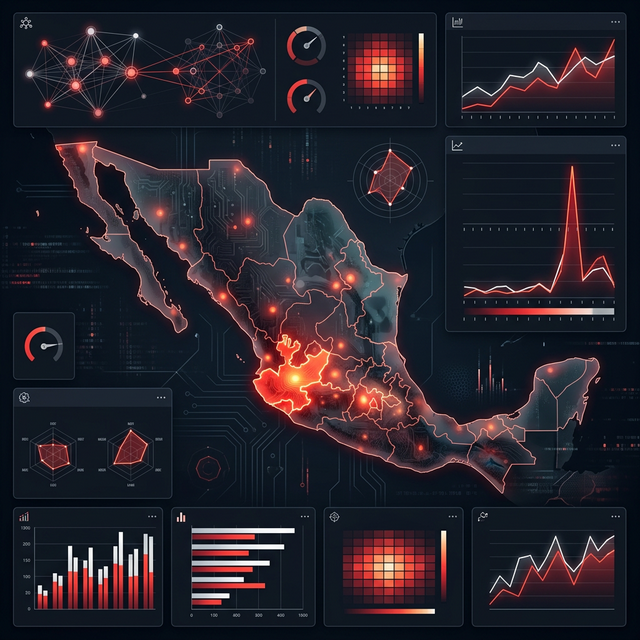
📊 CJNG Response Matrix: Feb 23 – Mar 4, 2026
- Confirmed Fatalities: 72 (including 25 National Guard members).
- Geographic Reach: Active blockades and fires across 20 Mexican states.
- State Response: 10,000 additional troops deployed under Sheinbaum's emergency order.
- Property Damage: 140+ vehicles and 12 government buildings burned.
The death of Nemesio "El Mencho" Oseguera Cervantes on February 22, 2026, in Tapalpa, Jalisco, was expected to be a "decapitation strike" that would bring the Jalisco New Generation Cartel (CJNG) to its knees. However, as of early March 2026, forensic data on the ensuing wave of violence suggest a different reality: a decentralized paramilitary organization capable of projecting power even after the loss of its iconic founder.
In the ten days following the operation, Mexico has witnessed one of the most coordinated bursts of organized crime violence in the modern era. Below, we break down the data behind the retaliation and what it signals for the 2026 security landscape.
1. The 20-State Blockade: Mapping the Geography of Violence
Unlike previous kingpin arrests where violence was localized, the CJNG response to El Mencho's killing was nationwide. Data from the Security Observation Center 2026 indicates that "narcobloqueos" (narco-blockades) were detected in 20 of Mexico's 32 states within four hours of the news breaking.
| Region | Intensity (1-10) | Fatalities (Feb 22-Mar 4) | Primary Incident Type |
|---|---|---|---|
| Jalisco (Core) | 10 | 28 | Heavy Firefights / IEDs |
| Guanajuato | 9 | 14 | Industrial Arson |
| Michoacán | 8 | 11 | Drone Strikes vs Military |
| Zacatecas | 7 | 6 | Highway Blockades |
| Colima | 8 | 5 | Port Infrastructure Attacks |
2. Institutional Attrition: The Cost to the National Guard
A startling data point from this period is the high ratio of security personnel among the fatalities. Of the 72 reported deaths, 25 were members of the National Guard. This 34% casualty rate for state forces is significantly higher than historical kingpin takedown metrics (usually under 12%).
This suggests that CJNG's "Special Forces" units—likely operating under new, lower-level commanders—are better equipped and more aggressive in their frontal engagements with military units in 2026. This data-driven insight has forced President Claudia Sheinbaum to deploy an additional 10,000 troops, bringing the total "CJNG-pacification" force to its highest level since the cartel's inception.
3. Strategic Resilience: Why CJNG Hasn't Collapsed
Financial analysts monitoring "Narco-Economics" in late February observed that despite El Mencho's death, there has been no significant interruption in CJNG's primary revenue streams (synthetic drug exports and extortion). This indicates that the financial node of the cartel was successfully insulated from the spiritual node (El Mencho).
- Decentralization: The cartel operates as a franchise model; regional "Plaza" bosses retain 70% of their operational autonomy.
- The Tapalpa Legacy: Items found in El Mencho's final hideout—crucifixes, handwritten psalms, and a golden casket—serve as martyr symbols, likely being used to recruit new "soldiers" in the wake of his death.
- Market Stability: Fentanyl precursor shipments arriving in Manzanillo showed zero volatility in the week following the strike, suggesting logistical continuity.
4. Forward-Looking Insight: The Succession Vacuum
The immediate threat for the remainder of 2026 is a multi-front war. Data on internal communications suggest three potential "New Generation" heirs are vying for control. History teaches us that the transition period is often bloodier than the kingpin's reign itself. Furthermore, rival syndicates, particularly the Sinaloa Cartel, are already showing data-spikes in territorial incursions in Michoacán.
We expect 2026 to be defined by "Network Warfare" rather than the pursuit of single figures. The data makes it clear: El Mencho is dead, but the economic and military infrastructure he built remains Mexico's most pressing challenge.
Frequently Asked Questions
Is El Mencho officially confirmed dead?
Yes. Mexican authorities and U.S. intelligence confirmed his death on February 22, 2026, following a special forces operation in Tapalpa, Jalisco. He was buried on March 2 in a golden casket in Guadalajara.
How did the 70+ deaths occur?
The majority of deaths occurred during coordinated retaliatory strikes by CJNG members across 20 states, involving roadside ambushes, attacks on military convoys, and "industrial sabotage" fires in urban centers like León and Guadalajara.
What is the current security status in Jalisco?
Jalisco remains under a "High Alert" security status with 10,000 additional troops deployed. While the initial wave of blockades has subsided, sporadic violence continues as internal power struggles within CJNG stabilize.