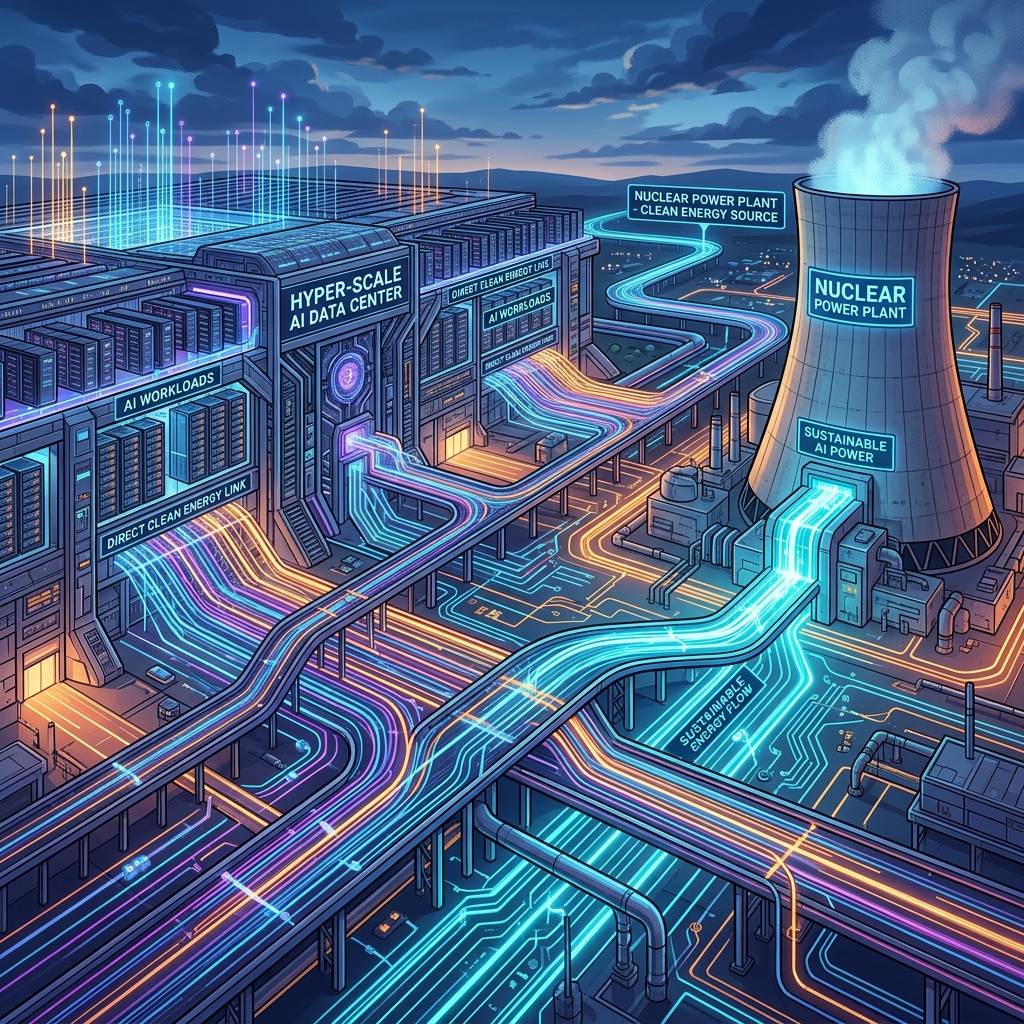
📊 2026 AI Power Demand & Nuclear Deals Snapshot
- The Baseload Mandate: A single 100,000 H100/H200 GPU cluster requires roughly 150 MW of continuous power. Hyperscalers cannot rely on solar or wind alone, which suffer from 70%+ intermittency rates.
- The Power Purchase Shift: Instead of buying offsets, tech companies are signing 20-year Power Purchase Agreements (PPAs) that tie data centers directly to physical nuclear stations (e.g., Microsoft's Constellation Energy deal).
- The Co-location Strategy: Amazon's acquisition of the Cumulus data center campus co-located at the Susquehanna Steam Electric Station marks a new trend: bypassing public grids entirely.
⚡ Deep-Dive Research: Nuclear vs. Solar SMR Economics
Explore capital expenditure, capacity factors, and Levelized Cost of Energy (LCOE) comparison data in our flagship energy report:
For years, Silicon Valley's public relations playbook was simple: run data centers on clean energy, purchase virtual power purchase agreements (PPAs), and buy carbon offset certificates to achieve "net-zero." But the exponential rise of generative AI models has shattered this clean facade.
Unlike traditional search or cloud databases, which execute bursts of calculation, training and running modern AI models requires continuous, uninterrupted maximum power. The scale of this consumption has collided with aging electric grids, prompting tech companies to secure the ultimate energy asset: nuclear power.
1. The Math Behind the AI Energy Appetite
To understand why tech companies are buying nuclear reactors, one must look at the power requirements of hyperscale AI infrastructure. An individual server rack holding modern AI chips consumes up to 40 to 100 kilowatts (kW) of electricity—nearly ten times the density of traditional cloud server racks.
A standard 100,000-chip GPU training cluster consumes roughly 150 Megawatts (MW) of power continuously. Multiplied across several facilities, the total demand is staggering. The International Energy Agency (IEA) estimates that global data center energy consumption will double by 2026, reaching over 1,000 Terawatt-hours (TWh)—equivalent to the entire power consumption of Japan.
2. The Big Tech Nuclear Playbook: 2026 Deals
To solve the grid bottleneck, hyperscalers are no longer waiting for utilities to build new power plants. They are securing existing nuclear capacity directly.
In one of the most high-profile energy transactions, Microsoft signed a massive 20-year PPA with Constellation Energy to revive the decommissioned Three Mile Island Unit 1 reactor (renamed the Crane Clean Energy Center). This deal will bring 835 MW of clean, reliable baseload power online exclusively for Microsoft's cloud infrastructure.
Similarly, Amazon Web Services (AWS) acquired the Talen Energy Cumulus data center campus in Pennsylvania for $650 million. The facility is connected directly to the adjacent 2.5 Gigawatt (GW) Susquehanna Steam Electric Station. By co-locating, Amazon avoids grid transmission congestion charges and ensures 100% nuclear reliability.
Comparison of Major Tech-Nuclear Initiatives
| Tech Giant | Energy Partner | Project / Source | Capacity Secured | Strategy Type |
|---|---|---|---|---|
| Microsoft | Constellation Energy | Crane Clean Energy Center (Three Mile Island) | 835 MW | Direct 20-year PPA |
| Amazon (AWS) | Talen Energy | Susquehanna Nuclear Station | 960 MW (Scale up to) | Campus Co-location |
| Kairos Power | Small Modular Reactors (SMRs) | 500 MW (Target) | SMR Deployment PPA |
3. Why Solar and Wind Cannot Save the AI Boom
While solar and wind remain the cheapest sources of raw electricity, they lack the reliability required for AI training clusters. An AI training job runs for months across thousands of parallel chips. If power dips, the synchronization breaks, corrupting the training run and costing millions of dollars in compute time.
Solar runs at an average capacity factor of 24%, while wind operates at roughly 35%. Nuclear reactors, by contrast, maintain a capacity factor of 93%+, running continuously for up to 18 to 24 months before pausing briefly for refueling. The reliability difference forces tech giants to accept the higher price of nuclear energy over cheaper, intermittent renewables.
4. The SMR and Fusion Bet
Acquiring existing nuclear plants is only a short-term patch. The long-term future of tech-energy partnerships lies in Small Modular Reactors (SMRs). These advanced, factory-assembled reactors can be transported by truck and installed directly next to data center parks, bypassing public transmission grids completely.
Google has already contracted with Kairos Power to build a fleet of SMRs utilizing molten salt cooling systems, aiming to bring the first units online by 2030. Microsoft has similarly invested in Helion Energy, securing a PPA for commercial fusion power targeted for late 2028. While these timelines remain highly ambitious, the financial capital pouring from Silicon Valley has accelerated reactor design timelines faster than at any point in the last half-century.
Frequently Asked Questions
Why can't tech companies use batteries to store solar power for AI?
To back up a 150 MW data center campus for a single day of cloud cover, you would need a battery storage system larger than any currently built, costing hundreds of millions of dollars. The economics of battery storage for continuous industrial loads remain prohibitive compared to nuclear baseload power.
Will tech energy demand raise consumer electricity bills?
Yes. In regions with dense data center footprints, such as Northern Virginia or PJM grid territories, the massive increase in industrial demand is outstripping local utility supply. This grid strain forces utilities to keep fossil fuel plants online longer and invest in expensive transmission upgrades, the costs of which are often passed down to local residential consumers.