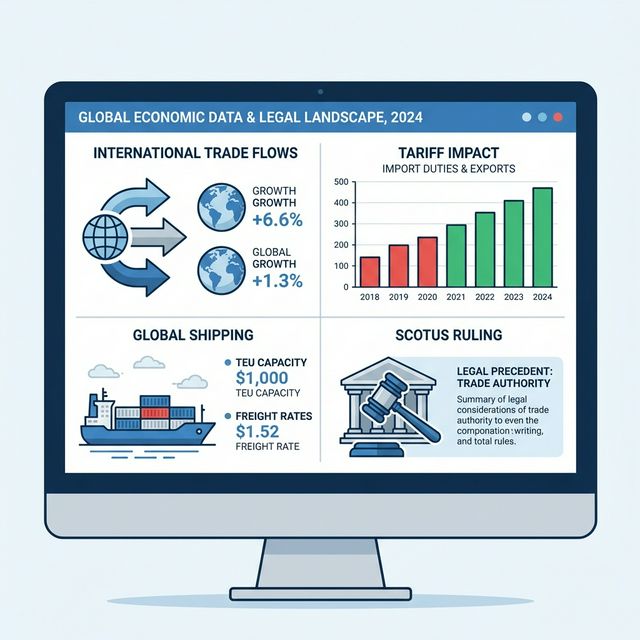
In a landmark decision in early 2026, the U.S. Supreme Court struck down the sweeping global tariffs implemented by Donald Trump under the International Emergency Economic Powers Act (IEEPA). The 6–3 ruling marks a significant constitutional check on presidential authority over international trade and commerce.
For the global economy, this decision introduces an immediate shift. The removal of these universal tariffs fundamentally alters the cost landscape for importers and signals a potential easing of geopolitical trade tensions. In this analysis, we will explore the legal reasoning behind the Court's ruling, the boundaries established for executive power, and the immediate implications for U.S. consumers, inflation, and global markets.
Why Did the Supreme Court Strike Down the Tariffs?
The Supreme Court’s 6–3 decision rested on the interpretation of executive authority and statutory overreach. The majority opinion argued that the administration misapplied the International Emergency Economic Powers Act to enact universal tariffs without congressional approval.
Historically, tariffs have been a legislative tool heavily reliant on Congress’s power to regulate commerce. The Court found that declaring a broad, undefined national emergency to bypass Congress for the sole purpose of implementing global tariffs violated the separation of powers. The ruling clarifies that while the President retains emergency powers, they cannot be used to permanently rewrite the U.S. tax and tariff code.
What Is the International Emergency Economic Powers Act (IEEPA)?
Enacted in 1977, the International Emergency Economic Powers Act grants the President broad authority to regulate commerce following the declaration of a national emergency. Traditionally, IEEPA has been utilized to enact targeted sanctions against specific foreign adversaries, hostile regimes, or terrorist organizations.
The Trump administration's use of IEEPA to levy generalized tariffs on allied and adversarial nations alike was historically unprecedented. The Supreme Court's 2026 ruling effectively reins in this interpretation, establishing a precedent that IEEPA was intended for acute, targeted emergencies rather than universal trade restructuring.
How Will This Affect U.S. Trade and Inflation?
The immediate fallout of the Supreme Court ruling promises cascading effects across domestic and international markets.
For U.S. Consumers and Inflation:
The nullification of these tariffs is expected to bring immediate relief to U.S. consumers. Tariffs function as a tax on imported goods, the costs of which are typically passed down to the retail level. With these costs removed, economists project a cooling effect on core inflation, particularly in sectors heavy reliant on imported raw materials and consumer electronics.
For Businesses and Importers:
U.S. businesses that rely on global supply chains will see significantly reduced operational costs. The ruling eliminates the friction and financial burden of blanket import taxes, allowing companies to stabilize pricing models and invest in domestic expansion.
For Global Trade Partners:
International markets reacted positively to the decision. Global trade partners, previously entangled in retaliatory tariff cycles, are interpreting the ruling as a stabilization of U.S. trade policy. This fosters a more predictable environment for international commerce and diplomatic trade negotiations. (Internal Link Suggestion: Read our analysis on GDP and Market Trends)
Can the Tariffs Be Reinstated?
If the executive branch wishes to reinstate broad global tariffs, it must now go through Congress. The Constitution explicitly grants Congress the power to levy taxes and regulate foreign commerce. Bipartisan congressional action is substantially more difficult to coordinate than executive fiat, making the immediate return of universal tariffs highly unlikely.
Looking forward, this ruling forces a return to traditional, legislation-driven trade policy. While the executive branch retains the ability to use targeted sanctions, sweeping economic blockades will require robust legislative backing.
FAQ: The Supreme Court Tariff Ruling
What was the Supreme Court's ruling on Trump's tariffs?
In a 6–3 decision, the U.S. Supreme Court struck down Donald Trump’s global tariffs, ruling that the use of the International Emergency Economic Powers Act (IEEPA) for universal import taxes exceeded executive authority.
Why did the Supreme Court strike down the tariffs?
The Court determined that declaring a broad national emergency to unilaterally impose global tariffs bypassed Congress's constitutional authority to regulate commerce and levy taxes.
Will prices go down because of the Supreme Court ruling?
Yes, economists expect prices on imported goods to decrease. Removing the tariffs lowers costs for importing businesses, which typically passes those savings on to consumers, likely helping to lower inflation.