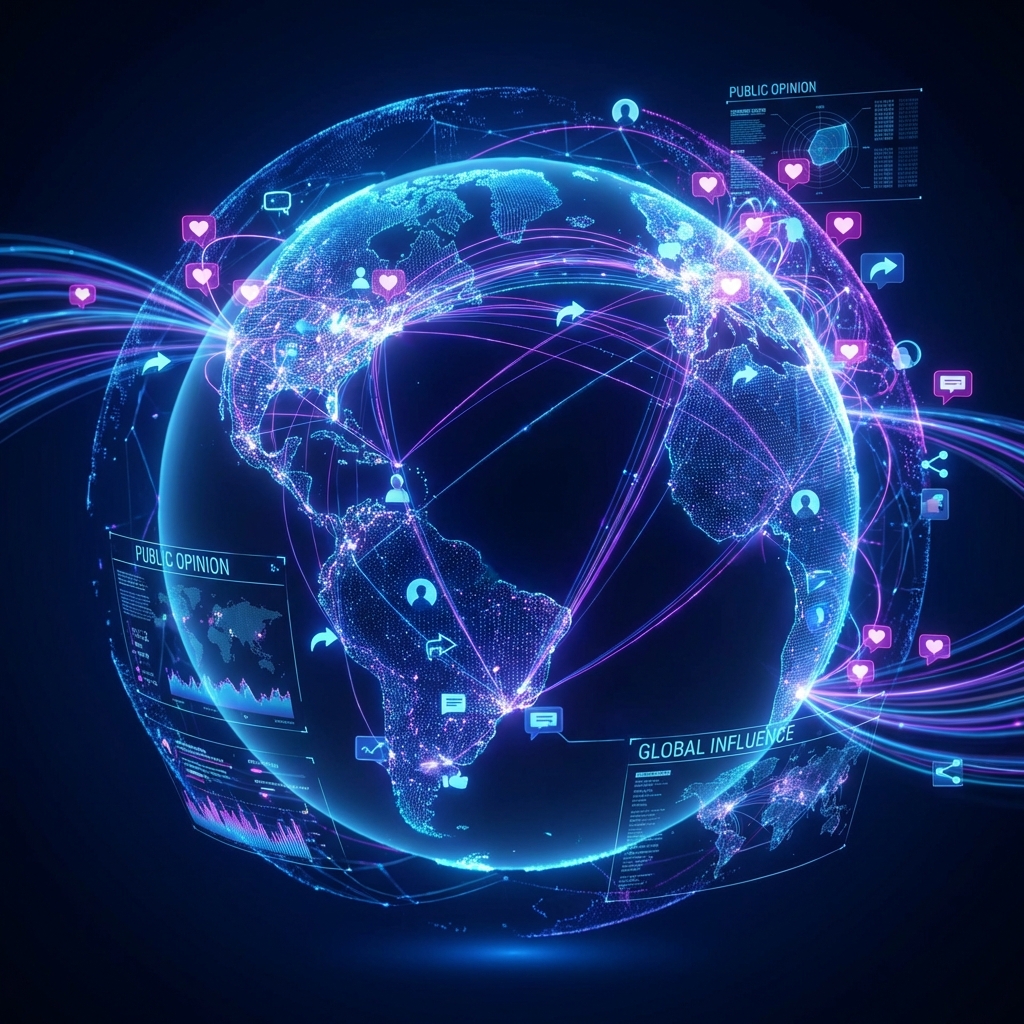
📊 The Scale of Social Media's Influence
- Global Reach: Over 5.04 billion people use social media globally—62.3% of the world's population.
- Daily Usage: The average person spends 2 hours 23 minutes per day on social platforms.
- Political Impact: 72% of adults now get their news primarily from social media rather than traditional sources.
- Echo Chamber Effect: Algorithms create content bubbles where 87% of users see only viewpoints aligned with their existing beliefs.
Imagine waking up to a world where your opinions aren't entirely your own. Where the articles you read, the videos you watch, and the conversations you join are all curated by invisible algorithms designed to keep you engaged—not informed. This isn't a dystopian future. It's today.
Social media has fundamentally transformed how public opinion is formed, shared, and manipulated. From elections in democracies to social movements in authoritarian states, the platforms we scroll through daily have become the primary battleground for hearts and minds. The question isn't whether social media influences public opinion—it's how deeply, and who controls the narrative.
1. The Unprecedented Scale of Digital Influence
Social media's reach is staggering. As of 2026, more than 5 billion people actively use social platforms. That's nearly two-thirds of humanity. The average user spends over two hours daily scrolling, liking, and sharing—time that was once spent consuming traditional media like newspapers or television.
What makes this shift profound is not just the volume of users, but the nature of consumption. Traditional media operated on a broadcast model: one source, many receivers. Social media operates on a network model: everyone is both a creator and a consumer. This democratization of content creation sounds empowering, but it also means misinformation spreads as fast as truth—sometimes faster.
2. Algorithmic Curation: The Invisible Hand
Here's the uncomfortable truth: you don't choose what you see on social media. Algorithms do. Platforms like Facebook, Instagram, TikTok, and X (formerly Twitter) use sophisticated machine learning models to predict what will keep you engaged. The goal isn't to inform you—it's to maximize your screen time.
Research shows that content triggering strong emotional reactions—especially anger or outrage—receives significantly more engagement. A 2025 study found that posts containing moral or emotional language were shared 20% more often than neutral content. This creates a perverse incentive: the most divisive content gets the most visibility, while nuanced, balanced perspectives are buried.
The result? Echo chambers. Data indicates that 87% of users primarily see content that aligns with their pre-existing beliefs. When you're only exposed to one side of an argument, it doesn't feel like a bias—it feels like reality. This is how social media doesn't just reflect public opinion; it actively shapes it.
3. Elections and Political Movements: The New Battleground
Social media has become the most powerful tool in modern political campaigns. In the 2024 U.S. presidential election, candidates spent over $1.2 billion on social media advertising—more than on television for the first time in history. Why? Because the data shows it works.
Micro-targeting allows campaigns to deliver personalized messages to specific voter segments based on their online behavior, demographics, and even psychological profiles. A swing voter in Pennsylvania might see a completely different ad than a progressive in California, even if they're supporting the same candidate. This level of precision was impossible in the era of broadcast media.
Beyond elections, social media has fueled social movements worldwide. The Arab Spring, Black Lives Matter, and climate activism all gained momentum through viral hashtags and coordinated online campaigns. But the same tools that empower grassroots movements can also be weaponized. State actors and bad-faith groups use bots, fake accounts, and coordinated disinformation campaigns to manipulate public sentiment at scale.
4. The Misinformation Crisis: Speed vs. Truth
False information spreads six times faster than accurate information on social media, according to a landmark MIT study. The reason is simple: lies are often more sensational than facts. They're designed to provoke, to shock, to go viral.
During the COVID-19 pandemic, misinformation about vaccines, treatments, and government policies spread rapidly across platforms, leading to real-world harm. The World Health Organization labeled it an "infodemic"—a flood of information, both true and false, that made it nearly impossible for the average person to discern reality.
The challenge is structural. Social media platforms profit from engagement, not accuracy. Fact- checking initiatives exist, but they're often slow and reactive. By the time a false claim is flagged, it may have already been seen by millions. The damage is done.
5. Regional Variations: How Influence Differs Across the World
Social media's influence isn't uniform. In democracies with strong press freedoms, platforms compete with traditional media for attention. In authoritarian states, social media is often the only space for dissent—and governments know it.
China's "Great Firewall" blocks Western platforms and tightly controls domestic alternatives like WeChat and Weibo. Russia has ramped up censorship and surveillance of social media, especially since 2022. In India, the world's largest democracy, WhatsApp has become a primary vector for political messaging and, unfortunately, communal violence fueled by viral misinformation.
In contrast, countries like the European Union have taken a regulatory approach, implementing laws like the Digital Services Act to hold platforms accountable for harmful content. The effectiveness of these measures is still being tested, but they represent a growing recognition that social media's influence requires oversight.
6. The Psychological Dimension: How Platforms Exploit Human Behavior
Social media platforms are engineered to be addictive. Features like infinite scroll, push notifications, and "like" counts trigger dopamine releases in the brain, creating feedback loops that keep users coming back. This isn't accidental—it's by design.
Former employees of major tech companies have spoken publicly about how platforms use behavioral psychology to maximize engagement. The goal is to make the app feel indispensable, to make logging off feel like missing out. This constant connectivity doesn't just change how we consume information; it changes how we think.
Studies show that heavy social media use is correlated with increased anxiety, depression, and polarization. When your worldview is constantly reinforced and opposing views are framed as threats, empathy erodes. Nuance disappears. Public discourse becomes a zero-sum game.
Looking Ahead: Reclaiming Agency in the Algorithm Age
Social media isn't going away. Its influence on public opinion will only grow as platforms integrate AI, virtual reality, and new forms of immersive content. The question is whether we, as users and citizens, can reclaim some measure of control.
This starts with awareness. Understand that what you see is curated. Seek out diverse sources. Question viral claims before sharing them. Support journalism and fact-checking organizations that prioritize truth over clicks. And demand accountability from the platforms themselves— through regulation, transparency, and ethical design.
Public opinion has always been shaped by media. But never before has the shaping been so personalized, so pervasive, and so invisible. The algorithms know what you'll click. The question is: do you?
Frequently Asked Questions
How do social media algorithms decide what I see?
Algorithms analyze your past behavior—what you like, share, comment on, and how long you watch videos. They prioritize content that maximizes engagement, often favoring emotional or controversial posts over balanced information.
Can social media really change election outcomes?
Yes. Data shows that targeted social media campaigns can influence voter turnout and preferences, especially among undecided voters. Micro-targeting and personalized messaging make these campaigns highly effective.
What are echo chambers, and why do they matter?
Echo chambers are digital environments where you're primarily exposed to viewpoints that align with your own. They matter because they reduce exposure to diverse perspectives, increase polarization, and make it harder to find common ground.
How can I avoid misinformation on social media?
Verify claims by checking multiple credible sources, look for original data or studies, be skeptical of sensational headlines, and use fact-checking websites like Snopes or FactCheck.org before sharing content.