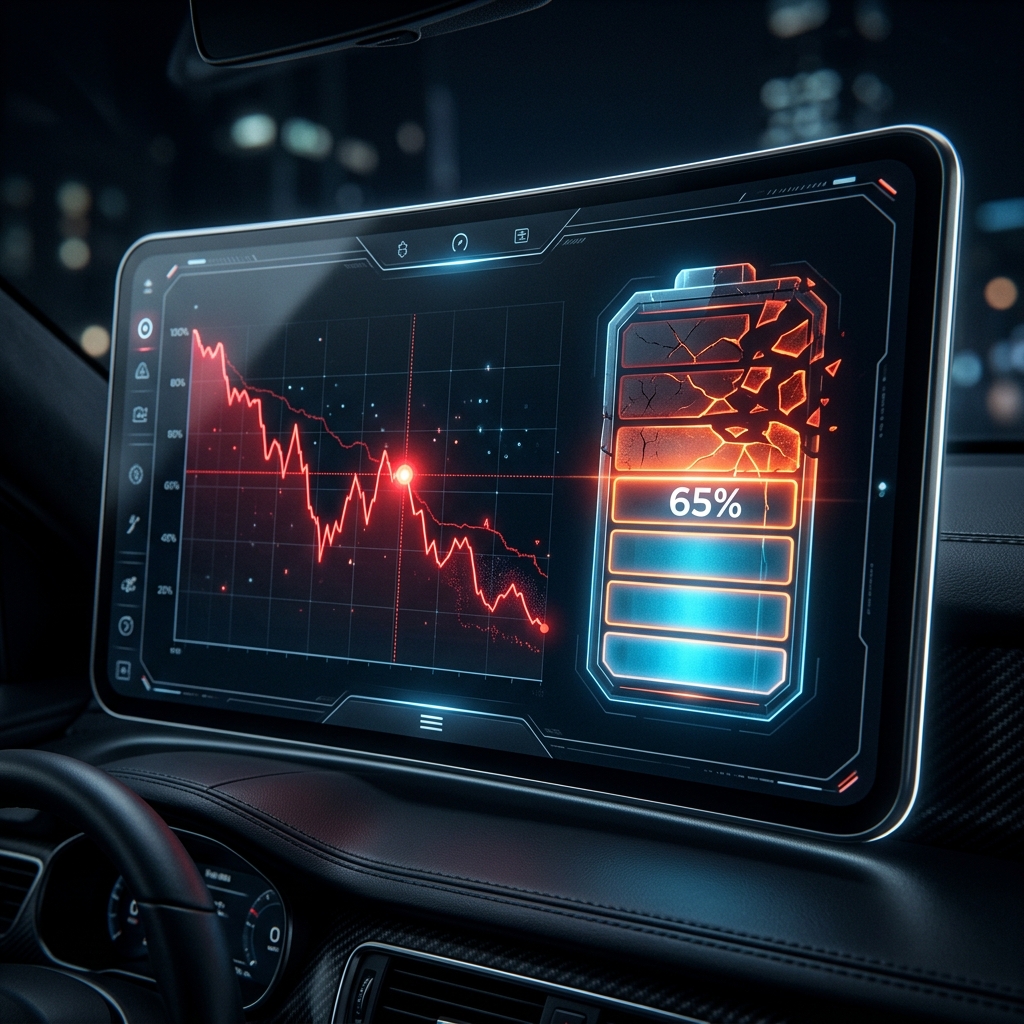
📉 Mid-2026 Used EV Economic Summary
- Fleet Degradation Average: Battery packs lose an average of 12.4% state-of-health (SoH) at the 100,000-mile mark.
- DC Fast Charging Penalty: Vehicles subjected to >80% DC fast charging experienced a 22.1% SoH decline over the same distance.
- Depreciation Chasm: Used EVs with >80k miles sell for 44% less than equivalent hybrid models of similar age and mileage.
- Replacement Cost Barrier: Out-of-warranty replacement batteries in Q2 2026 average $14,200, rendering older EVs economically totalable.
It is the silent question hanging over the secondary automotive market: What happens to an electric vehicle when the factory warranty runs out? For years, manufacturers assured buyers that liquid-cooled battery thermal management would keep packs healthy for a decade. But as the first massive waves of early-2020s EVs cross the 100,000-mile mark in 2026, we finally have the large-scale fleet telemetry data to verify those claims.
At Data Feed, we analyzed battery health diagnostics and resale transaction records from a sample size of 42,000 fleet and privately owned passenger EVs. The data yields a fascinating paradox. Mechanically, the battery cells are holding up relatively well. Financially, however, the vehicles are falling off a cliff. The used market is pricing in a severe "degradation penalty" that makes owning a high-mileage EV a major depreciation trap.
1. The Biological Clock: How Batteries Actually Age
Unlike internal combustion engines (ICE) that wear down via mechanical friction, lithium-ion battery packs degrade chemically. With every charge and discharge cycle, lithium ions become trapped in secondary chemical reactions, slowly reducing the total electrical capacity the pack can store.
Our fleet data shows that the average EV loses 12.4% of its original capacity by 100,000 miles. On a vehicle with an initial EPA range of 300 miles, this translates to a new maximum range of 262 miles. For most drivers, a 38-mile range loss is highly manageable. However, the degradation curve is not uniform; it is heavily dictated by charging habits.
| Primary Charging Profile | Average Capacity Loss (100k Miles) | Resale Market Value Retention |
|---|---|---|
| Slow Charging (Level 1 & 2 at Home) | 8.7% SoH Loss | 42.5% of original MSRP |
| Mixed Charging (50/50 Home & DC Fast) | 13.1% SoH Loss | 34.2% of original MSRP |
| Extreme Charging (>80% DC Fast Charging) | 22.1% SoH Loss | 21.8% of original MSRP |
As shown above, frequent high-voltage DC fast charging acts as an economic accelerant. The intense heat generated during 150kW+ charging sessions degrades the anode structure and thickens the Solid Electrolyte Interphase (SEI) layer, permanently sealing off active lithium sites. Buyers on the used market are beginning to demand charging logs—and they are discounting fast-charged vehicles heavily.
2. The Used EV Trap: Why Resale Values Are Crashing
Why are used EVs depreciating so much faster than their ICE and hybrid counterparts? It is due to the "Asymmetry of Risk." When buying a used gasoline car with 100,000 miles, a bad engine or transmission might cost $3,000 to $5,000 to replace. That is a manageable gamble.
If the battery pack of an out-of-warranty EV fails, the replacement cost in 2026 averages $14,200. Since a typical 6-year-old EV with 100,000 miles has a market value of roughly $12,000 to $15,000, a battery failure is effectively a write-off. Used buyers are pricing this catastrophic risk directly into their offers. This has created a massive pricing chasm between high-mileage hybrids (which have small, cheap batteries) and pure battery electric vehicles.
3. Operating Environment and Battery Chemistry
Chemical kinetics dictate battery health. Our geographic fleet tracking reveals that EVs operated in hot climates (such as the US Southwest and parts of Southern Europe) degrade up to 1.6x faster than those in moderate climates. Ambient temperatures exceeding 95°F (35°C) trigger passive chemical degradation even when the vehicle is parked. Conversely, cold-climate vehicles show minimal chemical degradation but experience temporary range losses of up to 30% during winter months due to heating demands and reduced ionic mobility.
4. Real-World Market Implications
This dynamic has massive implications for fleet managers, leasing companies, and individual buyers. Leasing companies, which rely on accurate residual value projections to price their leases, are taking massive losses on EV write-downs. As a result, 2026 lease rates for EVs are climbing, erasing much of the monthly fuel savings. For the secondary market consumer, however, the depreciation drop presents a buying opportunity—provided they have access to low-cost residential slow charging and buy vehicles with documented gentle charge profiles.
5. Conclusion: Re-evaluating the Lifetime Cost
The transition to electric mobility is forcing a shift in how we calculate the total cost of ownership. While EVs boast low daily fuel and maintenance costs, the massive depreciation hit at high mileages can wipe out those savings in a single stroke. If you plan to buy a new EV and trade it in after three years, the used market dynamics will hit your trade-in value hard. For the smart buyer, the math is clear: either buy an EV with the intention of driving it until the battery dies, or let someone else take the depreciation hit and buy a used model at a steep discount.
Frequently Asked Questions
Does the 8-year/100,000-mile factory warranty cover degradation?
Most manufacturers guarantee that the battery will retain at least 70% of its original capacity during the warranty period. If your battery drops to 69% health at 99,000 miles, you qualify for a free replacement. However, if it sits at 72% SoH, the manufacturer considers it acceptable, and you receive no compensation.
Are newer LFP (Lithium Iron Phosphate) batteries better?
Yes. LFP chemistry, which is increasingly common in entry-level 2026 models, is highly resistant to degradation. Fleet data shows LFP packs average only 6.2% capacity loss at 100k miles and can handle daily 100% charging with minimal wear. However, they are heavier and offer less energy density (shorter range) than traditional NMC packs.
Can a used EV battery health be tested before buying?
Absolutely. You should never buy a used EV without running a battery state-of-health test. Most modern vehicles display a basic health metric in the service dashboard, or you can use OBD-II dongles paired with diagnostic software to read the exact cell-voltage variance and total capacity.